A shopping mall gives robots a harder test than a closed warehouse. People cross their paths, shops change their displays, and a route that works at 9 a.m. may be blocked by lunchtime. The useful question is where a robot can do one repeatable job without making the mall harder to use.
- Robots could move stock, clean shared areas, or guide visitors.
- Indoor navigation gets harder when crowds, furniture, and temporary signs keep changing.
- A mall needs clear savings and safe operation before it needs more robots.
The first jobs would be behind the scenes
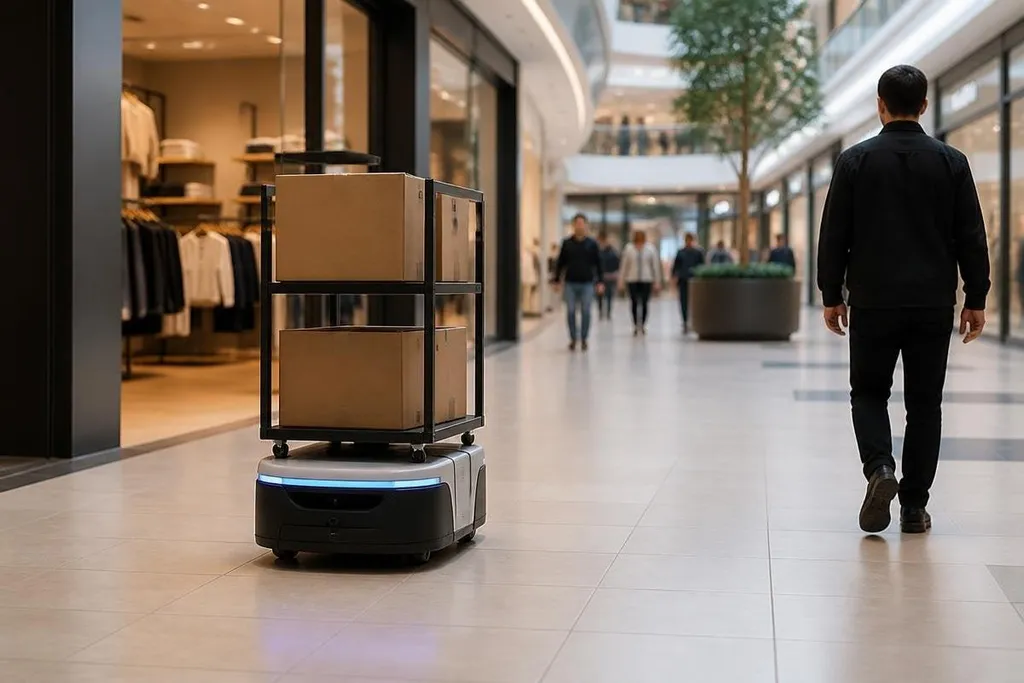
Stock movement is a practical starting point. A mobile robot could carry boxes between the loading area and a shop, follow a mapped route, and stop when a person crosses its path. That could reduce repeated walking for staff, but the robot still needs a clear handoff at the store door.
Cleaning is another possible fit. A floor-cleaning robot can repeat the same route during quiet hours, then return to its charging dock. It would still need staff to handle spills, crowded spaces, stairs, and places its brushes cannot reach.
These jobs have a shared feature: the robot can work within set boundaries. A mall operator can map corridors, mark restricted areas, and decide when the robot runs. Open-ended work among shoppers is much harder.
Public areas change the problem
A robot that carries stock can stop at a marked point. One that guides visitors has to deal with questions, blocked paths, noise, and people who do not follow its instructions. It may need a screen, a speaker, a camera, or a way to connect the visitor with a person.
Navigation also depends on more than a floor map. LiDAR measures nearby surfaces with laser light, while cameras can help the robot identify doors, signs, and people. Those sensors still need software that can react when a display stand moves or a crowd fills the usual route.
Safety comes before speed. The robot needs low travel speed in busy areas, a clear stop system, and a route that keeps it away from escalators and emergency exits. A mall may also need rules for charging, maintenance, data storage, and access for staff.
The work must fit the building
Every mall has its own layout and operating rules. A robot that works on a smooth ground floor may struggle with thresholds, lifts, glass doors, or a route split between public and service areas. The building may need small changes before the robot can do useful work.
Those changes can include marked parking points, charging space, network access, and doors that the robot can use safely. If staff must guide the robot through each difficult section, the labor savings shrink.
This is where the business case becomes specific. The operator needs to compare the robot's purchase or rental cost with staff hours saved, service costs, charging time, repairs, and the work needed to change the building.
A mall robot also has to work around shoppers, shop displays, and staff doors, so the operating plan needs more than a price sheet. Reports on mall robots can link the machine’s job to its route, staff support, and public limits before the next section looks at what shoppers may notice.
What shoppers may notice
Most useful mall robots would fade into the background. Visitors might see cleaner floors, faster stock movement, or a screen that gives directions. They may also see a machine stop and wait when a child, suitcase, or delivery cart blocks its route.
That pause matters. A robot that stops safely may serve a mall better than one that moves quickly but needs constant staff help. Public acceptance will depend on whether the machine is easy to understand and whether its cameras and recorded data have a clear purpose.
I think malls should start with service routes and cleaning before putting robots in charge of visitor help. Those tasks have clearer boundaries, so the operator can measure results without asking shoppers to adapt first.
A practical test for mall operators
Before a purchase, check the job against these points:
- Fixed route: Can the robot reach the same work points without staff guidance?
- Safe stop: Does it stop when a person or object enters its path?
- Building fit: Can it use the doors, lifts, ramps, and floor surfaces on that route?
- Staff handoff: Who loads, unloads, charges, cleans, and fixes it?
- Measured result: Which hours, trips, or service calls will the operator count?
- Public data: What cameras, recordings, and visitor information does the system collect?
The strongest first project will have a narrow route, a named owner, and a result the operator can count each week. If a robot cannot meet those conditions, the mall should fix the process before buying the machine.